About The Song
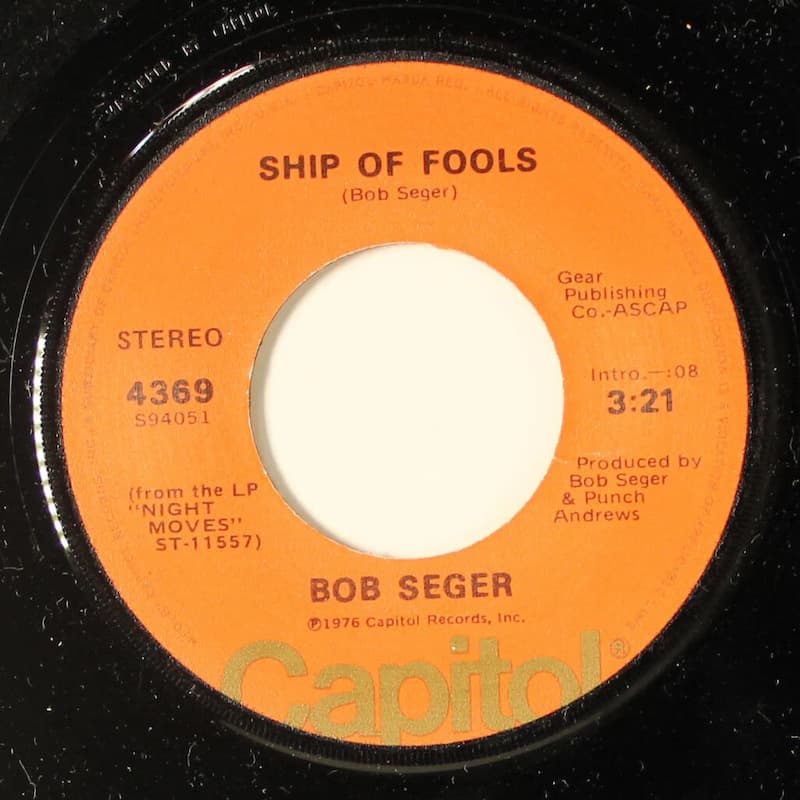
“Ship of Fools” is one of the moodier deep cuts on Bob Seger & the Silver Bullet Band’s breakthrough LP Night Moves, released by Capitol on October 22, 1976. Though not issued as a U.S. A-side, it reached a wide audience as the B-side of the hit single “Night Moves” that arrived the following month, which meant many listeners first met the song while flipping a 45 that was already burning up the charts.
On the album, “Ship of Fools” sits late in the sequence (Side Two, Track 4) and runs about 3:24. Unlike the Detroit-cut Silver Bullet Band material elsewhere on the record, this track was recorded at Muscle Shoals Sound Studios in Sheffield, Alabama and produced by the famed Muscle Shoals Rhythm Section. That switch of setting and personnel gives it a different grain—looser in the pocket, humid around the edges, and designed to let the lyric breathe.
The credits tell the story of that feel. Barry Beckett (keys), David Hood (bass), and Roger Hawkins (drums) anchor the track, with Muscle Shoals guitarists rounding the edges; Seger keeps the vocal close and unforced. There’s also an unexpected color in the arrangement: an accordion cameo by Jerry Luck that threads through the verses like heat shimmer, lending the performance a slightly rootsy undertow without turning it into pastiche.
Lyrically, Seger leans on a time-honored metaphor—the “ship of fools,” a centuries-old image in Western art and letters for a wayward crowd or a society drifting without a captain. Rather than lecture, he sketches scenes and types, letting the phrase do the moral work in the chorus. The result is characteristic of his mid-’70s writing: plainspoken, cinematic, and more observant than judgmental.
As a single-era artifact, “Ship of Fools” mattered even without chart lines beside its name. In the U.S., it rode shotgun on the “Night Moves” 45, a coupling that helped the album sustain momentum; in parts of Europe, the song even appeared on its own 7-inch. Pair those releases with the album sequencing and you get a good snapshot of how Seger and Capitol positioned it—as a supporting player with enough gravity to carry a side.
Contemporary press heard its potential. In a 1976 review, Cash Box singled out “Ship of Fools” as a cut that “might turn into a classic rocker,” an early nod to the song’s sturdiness amid an LP full of radio-ready moments. That assessment has aged well; the track remains a favorite for listeners who gravitate to Seger’s nocturnal, small-hours storytelling rather than his fist-in-the-air anthems.
Heard today, “Ship of Fools” feels like a necessary counterweight on Night Moves—the hushed, slow-burn scene that deepens the album’s portrait of desire, consequence, and grown-up clarity. It’s a compact production, a lived-in vocal, and a chorus that lands with more rue than roar. In other words, classic Seger—just with a Muscle Shoals moonlight glow.
Video
Lyric
“Tell me quick”, said Old McFee
“What’s this all have to do with me?
I’ve spent all my time at sea, a loner”
“Is there something else I should know?
Something hidden down below
The level of your conversation?”
Well, he turned away before the answer
Though I yelled aloud, he refused to hear
It became too clear
So it went, as we put out
I was left in constant doubt
Everything I asked about seemed private
The captain strolled the bridge one night
I stopped him in the evening light
To ask him, would it be all right to join him?
Well, he stood there like some idol
And he listened like some temple
And then he turned away
All along the fateful coast
We moved silent like a ghost
The timeless sea, a tireless host possessed us
The wind came building from the cold northwest
And soon the waves began to crest
Crashing ‘cross the forward deck, all hands lost
I alone survived the sinking
I alone possessed the tools
On that ship of fools
Ship of fools
On that ship of fools
That ship of fools