About The Song
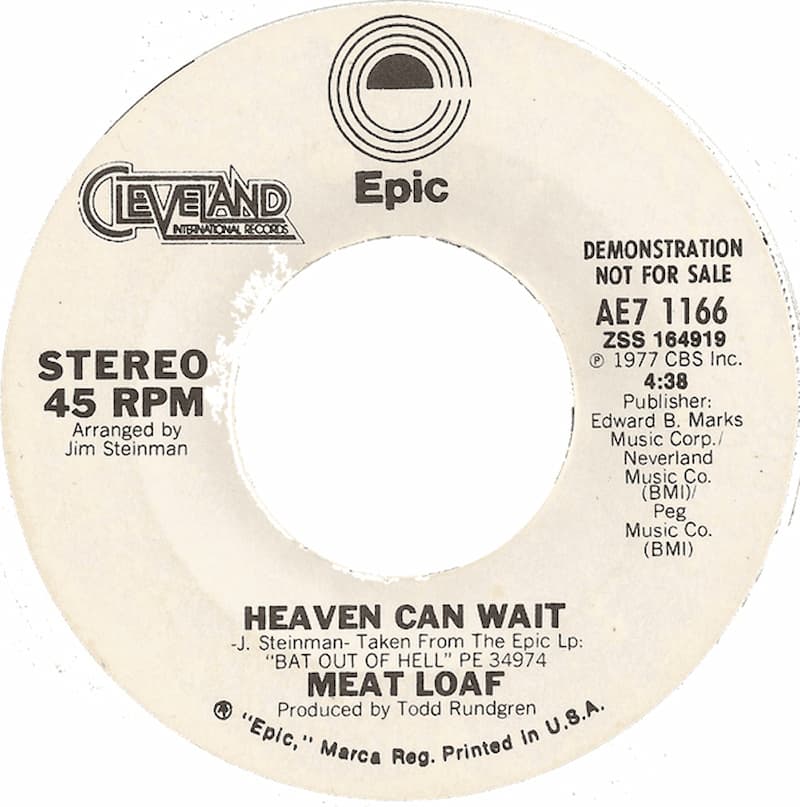
“Heaven Can Wait” is the quiet, aching heart of Meat Loaf’s blockbuster debut album Bat Out of Hell, released on October 21, 1977 by Cleveland International/Epic. On a record famous for motorcycles, teenage melodrama and operatic excess, this ballad offers something more intimate: just piano, voice and a swelling orchestral backdrop. It appears as the third track on side one, one of the album’s shorter pieces, and yet many fans and critics quietly single it out as one of Jim Steinman’s most moving compositions.
The song’s story actually begins before Meat Loaf stepped into the studio. Steinman originally wrote “Heaven Can Wait” for his Peter Pan–inspired rock musical Neverland, the stage work that would later feed several songs into Bat Out of Hell. Early in the 1970s, Bette Midler even sang a demo of the tune, famously asking Steinman what on earth the lyric was really about. By the time Meat Loaf recorded it between 1975 and 1976 with producer Todd Rundgren and a cast of rock and Broadway players, the song had evolved into a stand-alone showcase for his big, theatrical voice used with surprising restraint.
When Bat Out of Hell finally came out in 1977, it was not an overnight hit. The album had a slow build, eventually becoming one of the best-selling records in rock history, certified multi-platinum in the U.S. and holding a record-breaking run on the UK Albums Chart. As the LP climbed the Billboard 200 into the Top 20 and later returned to the charts decades on, “Heaven Can Wait” travelled with it, tucked between the better-known singles like “Two Out of Three Ain’t Bad” and “Paradise by the Dashboard Light.” The song itself was never a major A-side, but it did appear as the B-side of the single “Bat Out of Hell” in several territories, quietly reaching listeners through jukeboxes and turntables rather than radio countdowns.
At its core, the lyric is a meditation on love, mortality and a kind of stubborn hope. The singer insists heaven can wait because, for now, he carries a “band of angels” in his heart to get him through the cold nights and lonely days. It is not a simple, sugary love song; there is a sense of fragility and fear running underneath the promises, as if he knows darkness is always close by. That mixture of spiritual imagery and very human vulnerability is one reason the track has been used at both weddings and funerals, comforting people who are trying to hold on to love in the face of time and loss.
The music moves with the calm assurance of a hymn. A gentle piano line opens the song, joined by soft strings and a carefully shaped orchestral arrangement that slowly rises without ever turning bombastic. Steinman’s melody mostly flows downward, giving the sense of a river slipping through a valley, and Meat Loaf reins in the explosive rock-musical power he uses elsewhere on the album. He sings in long phrases, letting syllables linger on the edge of a tremor, sounding less like a swaggering rock frontman and more like a man alone at midnight, talking to someone he hopes can hear him.
Around the song, a web of backstage stories has grown. Ellen Foley, who sang on several other Bat Out of Hell tracks, performed “Heaven Can Wait” onstage in the Neverland musical in the late 1970s, giving it a life outside the album. Karla DeVito, who mimed Foley’s parts in Meat Loaf’s videos and joined his touring band, later cut her own version on a 1981 solo record after singing it on the road as the one truly quiet moment in an otherwise explosive live set. Singers who worked with Steinman often spoke of the song as if it had come through him rather than simply been written, describing it as something almost “channeled” from a higher place.
Over the years, “Heaven Can Wait” has taken on a second life far beyond its original track listing. It has lent its title to a best-of compilation, inspired blog essays and fan tributes, and become the kind of deep cut that devoted listeners play for friends when they want to show the softer, more spiritual side of Meat Loaf. In a catalogue full of grand gestures and dramatic set pieces, this song stands apart as a moment of stillness. It captures the larger Bat Out of Hell myth—romantic, gothic, over-the-top—then turns inward and whispers: love is worth staying for a little longer, so heaven will simply have to wait.
Video
Lyric
Heaven can wait,
And a band of Angels wrapped up in my heart,
Will take me through the lonely night,
Through the cold of the day.
And I know, I know,
Heaven can wait,
And all the gods come down here just to sing for me,
And the melody’s gonna make me fly,
Without pain, without fear.Give me all of your dreams,
And let me go alone on your way.
Give me all of your prayers to sing,
And I’ll turn the night into the skylight of day.
I got a taste of paradise,
I’m never gonna let it slip away.
I got a taste of paradise,
It’s all I really need to make me stay
Just like a child again.Heaven can wait.
And all I’ve got is time until the end of time.
I won’t look back.
I won’t look back.
Let the altars shine.And I know that I’ve been released,
But I don’t know to where,
And nobody’s gonna tell me now,
And I don’t really care. No, no, no.
I got a taste of paradise.
That’s all I really need to make me stay.
I got a taste of paradise.
If I had it any sooner you know
You know I never would have run away from my home.Heaven can wait.
And all I’ve got is time until the end of time.
I won’t look back.
I won’t look back.
Let the altars shine.Heaven can wait.
Heaven can wait.
I won’t look back.
I won’t look back.
Let the altars shine.
Let the altars shine.